Greetings,
friends! I'm admittedly cheating slightly with this post, as it's a piece I
wrote for my recently begun graduate program in writing, but I want to keep
writing here. I'm still working out what it'll consist of reguarly, but I figure this
piece is a good place to start. As last year's posts made clear, Little
Women has been on my mind frequently, and, in exciting news, I
recently visited the Alcott house for the second time! This reflection was written with my first visit there in mind, and in anticipation of the second. The story of the March sisters and
their parents continues to inspire and give me courage, and I certainly want
this space to be one that celebrates courage and beauty. I hope this short
missive in honor of the Marches and their author does that and perhaps
encourages you to pick up Little Women for the first, or maybe the one
hundred and first, time :)
It’s like stepping back in time,
I thought in excited wonder. The countless nights spent with my battered
paperback copy of Little Women came rushing back as I walked up the
drive of the Alcott Orchard House. The famous soundtrack from the 1994 movie
rang through my mind. Of all the sights to see in Boston and the surrounding
area, this little house on a quiet street in Concord called my name most of all,
for here Louisa May Alcott had penned her famous 1868 story of the March
family, inspired by her own family, that would thrill generations of young
women after her. For me, Little Women had always presented a compelling
picture of family, love, pursuit of dreams, and growth into womanhood.
Traversing to its place of origin now offered me the chance for fresh
reflection on its formative influence.
Everywhere
I looked inside Orchard House surfaced more memories and images. The family
room looked exactly like it did in the movie. That’s where Marmee reads
letters from Father to the four girls, I mused, studying the large easy
chair by the fireplace. Will I have a family to sit by a cozy fire with
someday? I’d definitely want to be a mom like Marmee. Across the hall stood
the dining room, where the March sisters famously decided to give away their
Christmas breakfast to a family in need, effected by their mother’s
encouragement. I hope I’d inspire that kind of virtue in daughters of my own
one day.
The
tour group wound its way upstairs. Every turn brought images and scenes to
mind. Here in the hallway, Jo and Meg had paced nervously while waiting for
news of Beth’s illness. In that bedroom, Beth and Amy had whispered and giggled
into the night as young girls. We enter another bedroom and pause to admire an
authentic, well-preserved gown from the 1860s. The guide explains it belonged
to Anna Alcott, Louisa May’s elder sister and the inspiration for Meg March of Little
Women. It seems appropriate to display a fashion item in honor of “Meg,”
who wrestles with materialism and vanity throughout the novel. But the gown on
display boasts simple patterns and colors, perhaps reflective of Meg’s growth.
The beautifully admonishing words of the film version’s Marmee come to my mind:
“If you feel
that your value lies in being merely decorative, I fear that someday you might
find yourself believing that’s all that you really are. Time erodes all such
beauty. But what it cannot diminish is the wonderful workings of your mind,
your humor, your kindness, and your moral courage. These are the things I
cherish so in you.”
As
a young girl reading Little Women, I cherished those aspects of Meg too,
as I did various quirks of each sister. Unlike many readers of the novel, I
never strongly preferred one sister over the rest, but found characteristics I
loved in all four. Meg’s tender and motherly spirit, Jo’s writerly ambitions,
Beth’s love of home and family, and Amy’s fascination with beauty all spoke to
me. And at the quiet and steady helm of their struggles into womanhood, their
mother kept faithful watch, gently guiding and rebuking and encouraging each of
them into the best versions of themselves. In the March women, I found early
models of courage, virtue, and femininity to emulate, and they represented the
family I dreamed of making one day.
The
old walls of Orchard House bring the Marches closer than ever. To how many
childlike dreams, whispered hopes, family arguments, and murmured prayers has
the worn wallpaper borne witness through the centuries? How many young women
like me does it now usher into nostalgia every day? I stop short as I pass Anna
Alcott’s dress and come to a small, simple table surface cut out of the wall.
Here, shares the tour guide, likely marks the place where Louisa May Alcott
wrote most of Little Women. Tears sting my eyes. Here she sat more than
a hundred years ago to bring Marmee, Meg, Jo, Beth, and Amy to life. Did she
have any idea how much they would speak to girls like me? How their story would
become such a significant girlhood rite of passage for so many? I let my
fingers reverently brush the old wooden surface before turning back out of the
bedroom.
Back
outside, I turn to gaze at the beautiful, simple front of the house once more.
The realization of all I owe to the Alcotts and their fictional counterparts in
the Marches strikes me anew now that I see the home in which they lived and
learned. In each March sister, I found role models for family, friendship, and
pursuit of dreams. They showed me virtue lived courageously and love given
unconditionally. Marmee offered me an example of joyfully embracing motherhood
with all its trials and blessings. I hope I can make a home like this one day,
I murmur inwardly, turning back up the street. Hope flares brightly inside
me as Orchard House fades into the distance, its images burned into my mind.
Hope for a home, a family, the warmth of a shared hearth, and days filled with
love and laughter.
***
I
sigh in contentment from my couch in Washington, D.C. Candles burn, friends sit
around me with sewing projects, and the newest film adaptation of Little
Women plays in the foreground. The famous words of Mr. March’s letter from
the book play in voiceover as the sisters excitedly perform a play for
neighboring children:
“I
know they will remember all I said to them, that they will be loving children
to you, will do their duty faithfully, fight their bosom enemies bravely, and
conquer themselves so beautifully, that when I come back to them, I may be
fonder and prouder than ever of my little women.”
My
heart swells with affection for the women around me. My home may not look like
Orchard House, and I may not yet have daughters to love, but I can invite
others into my everyday spaces now. I keep re-reading and studying Little
Women these days, and I reminisce often on my visit to Orchard House. Then,
I didn’t fully understand that while the Marches certainly encourage hope for
good things, they also make a case for relishing the beauty of the present.
Yes, hope for a family and a shared fire, but also make a home in your little
D.C. townhouse that lacks a working fireplace. Make it a place that invites
friends to gather and love to be shared. In doing so, maybe you’ll see a little
taste of Orchard House right in front of you. Tears prick my eyes as I watch
Marmee on the screen applauding her girls’ performances. I want to be like
her, I ponder. If I have daughters, yes, but also right now.
For me, 2019 was a year of learning to honestly process disappointment and grieve well during relatively normal times. So, when cancellations, isolation, and anxiety began to grip the world this year, I was surprisingly thankful for the practice of 2019, hard as it was at times. Grief and disappointment are common to humanity, but we’re still filled with questions and confusion when they first strike. And no matter how large or small the cause for a particular grief may be, facing it honestly and maturely is important and requires intentionality.
As a lifelong lover of good stories, I’m a firm believer in the power of stories to help us grow in any area of life, sorrow being no exception. To that end, I’m returning to Little Women, one of my favorite books and one that explores grief with candor, empathy, and thoughtfulness. Only recently have I realized how much this well-beloved story has to do with grief, and I was fittingly re-reading it when the pandemic began to wreak havoc in my community. Since then, I’ve been strengthened and helped by its messages on loss and sorrow. So, whether you’re grieving the death of a loved one, widespread injustice, or cancelled plans that were dearly held, I hope this book’s handling of grief and the reflections I share here from my reading may help you face it with a little more clarity and move forward with a little more hope.
(Disclaimer: Spoilers, spoilers, spoilers everywhere)
Little Women’s Great Grief: Beth March’s Fate
Little Women has been analyzed and re-read throughout generations since its publication in 1868, and yet, as Greta Gerwig’s lovely new film adaptation has lately proved, it continues to stand the test of time. It endures because it explores universal themes, such as growing up, family dynamics, love, and, necessarily, grief, through the untimely death of one of the story’s four “little women.” Mixed feelings abound among Little Women fans regarding the third March sister, Beth, and her sad end. She battles painful shyness, but always exudes kindness, generosity, and tenderness. Indeed, for some, her unfailing selflessness makes her death feel inevitable and cliché, and they may nod in agreement when second sister Jo says, “The good and dear people always do die” (Alcott, p. 212). Others struggle to like Beth, as her constant goodness can seem almost martyr-like, while still others have argued that her death is merely a convenient plot device used to inject conflict. But upon close reading, this death elicits raw emotion and invites readers to thoughtfully examine death and grief, primarily through Beth’s courageous acceptance of her end, and through Jo’s pained reckoning with the loss.
Beth’s Courage
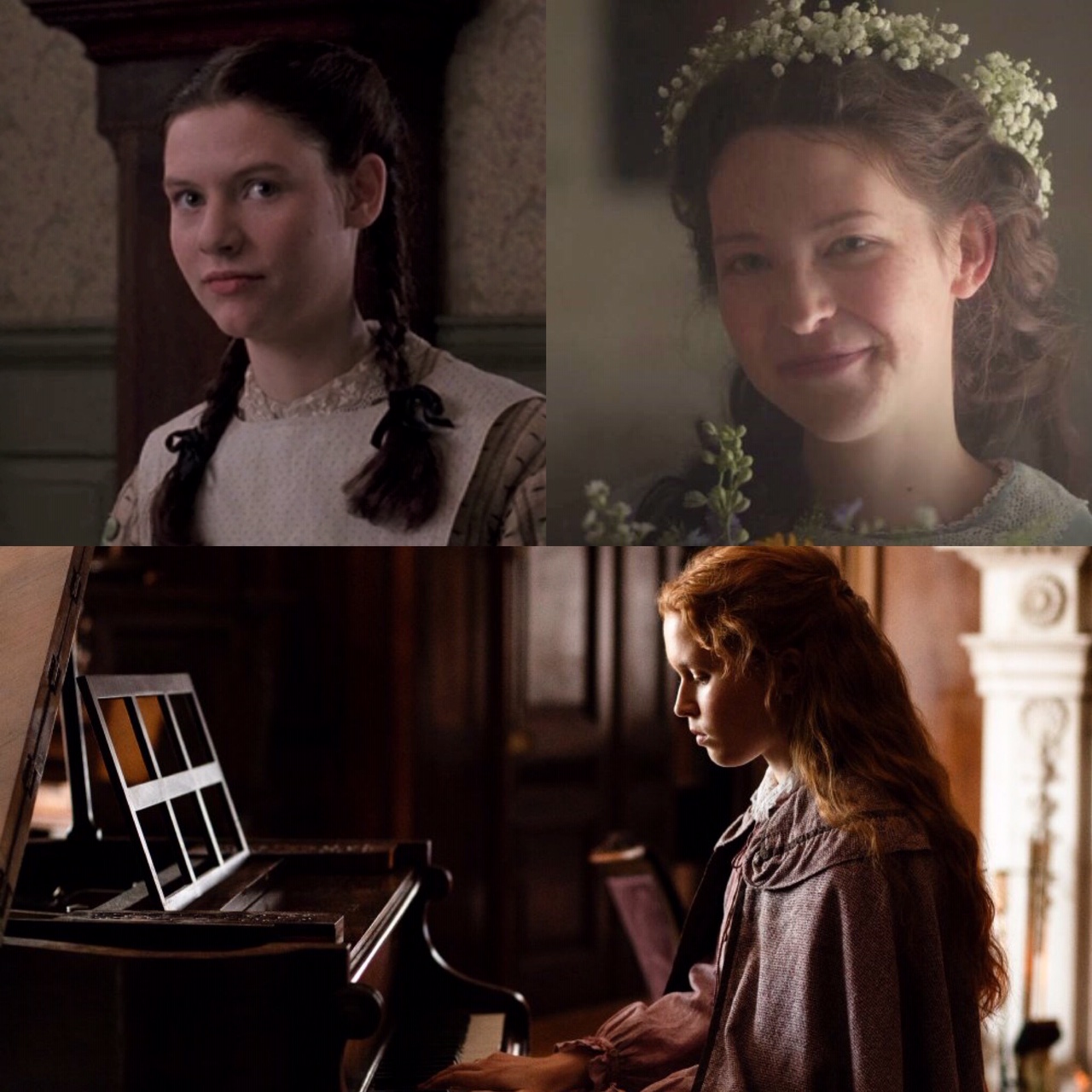
Top L, Top R, Bottom: Claire Danes, Annes Elwy, and Eliza Scanlen as Beth March (1994, 2017, 2019 respectively) [Sources: Forever Young Adult, WGBH, BFI]
Beth may be the most fragile character in Little Women, and her propensity for service may seem overly saint-like to some, but, paradoxically, it is in preparing to meet death, that most dreaded of human enemies, that she demonstrates victory over the fear with which she has struggled her whole life. Shyness and anxiety are Beth’s marked traits. She sticks close to home, fears talking to new people and trying new things, and thrives best amidst quiet and familiarity, pouring her heart into serving those she knows and loves. True to her natural reserve, when she first realizes her time is waning, she keeps the knowledge locked away, perhaps out of some faulty martyrdom, but also out of genuine desire to keep a right perspective. By the time she confides in Jo, she has grown accustomed to her fate, but Jo’s grief helps Beth to truly grieve well as she prepares to depart life. She recognizes the gifts of life that she’s loath to give up, but also determines to devote her remaining time to making the world a bit happier for those she will leave behind. Beth fully acknowledges the pain, but also strives for peace with it, as the narrator aptly describes:
“Simple, sincere people seldom speak much of their piety; it shows itself in acts rather than words, and has more influence than homilies or protestations. Beth could not reason upon or explain the faith that gave her courage and patience to give up life, and cheerfully wait for death…She could not say, ‘I’m glad to go,’ for life was very sweet to her; she could only sob out, ‘I try to be willing,’ while she held fast to Jo, as the first bitter wave of this great sorrow broke over them together.” (Alcott, p. 428)
Beth’s sorrow is indeed great, but she never allows bitterness to take root in her heart and works hard to love others well as long as she can. And through both her quiet acceptance and efforts to prepare herself to depart life, her fear becomes secondary and those dear to her are made better for her example. The narrator summarizes Beth’s final days well:
“With the wreck of her frail body, Beth’s soul grew strong, and though she said little, those about her felt that she was ready, saw that the first pilgrim called was likewise the fittest, and waited with her on the shore, trying to see the Shining Ones coming to receive her when she crossed the river.” (Alcott, p. 476)
Jo’s Reckoning
Of those who wait with Beth on that proverbial “shore” before her death, none do so more faithfully than second sister Jo, and it is Jo who is also most changed by her own grief and by Beth’s example as Beth slips away. Jo is the opposite of Beth in every way – loud, stubborn, adventurous, and mischievous – and yet, of the four March sisters, the bond between these two is perhaps the closest and most tender. So, upon learning the hard truth of Beth’s impending death, Jo’s natural first response entails anger and rebellion. But as Jo devotedly cares for this beloved sister, rarely leaving her side as her days wane, Jo softens and learns to love and serve ever more willingly, and after Beth’s passing, Jo learns to live without despair, painful as her loss remains.
Eliza Scanlen as Beth and Saoirse Ronan as Jo in Greta Gerwig's "Little Women" (2019) [Source: YouTube]
As the narrative winds through Beth’s final days, Jo wrestles with resentment over losing Beth, but also allows her gentle sister to become her teacher in qualities she has always struggled to absorb. Historically, Jo was the brave and wild one, while Beth was quiet, meek, and looked up to Jo. But at this stage of the story, their roles are reversed as Beth’s courage to meet death teaches Jo greater humility and care for others. The narrator expresses Jo’s growth in bittersweet tones:
“…with eyes made clear by many tears, and a heart softened by the tenderest sorrow, [Jo] recognized the beauty of her sister’s life – uneventful, unambitious, yet full of the genuine virtues which ‘smell sweet, and blossom in the dust,’ the self-forgetfulness that makes the humblest on earth remembered soonest in heaven, the true success which is possible to all.” (Alcott, p. 477)
This painful maturation through loss is perhaps best expressed in a poem of Jo’s own writing which Beth accidentally finds on one of her last nights. The words are raw and honest about the ache of loss, but also demonstrate how Jo has accepted that she must learn to carry on with the virtues Beth has imparted to her. Even amidst heavy sorrow, Jo has clearly recognized her gains from years with Beth and even from watching her live out her final days with courage, as the poem expresses:
“O my sister, passing from me,
Out of human care and strife,
Leave me, as a gift, those virtues
Which have beautified your life.
Dear, bequeath me that great patience
Which has power to sustain
A cheerful, uncomplaining spirit
In its prison-house of pain…
“…Thus our parting daily loseth
Something of its bitter pain,
And while learning this hard lesson,
My great loss becomes my gain.
For the touch of grief will render
My wild nature more serene,
Give to life new aspirations,
A new trust in the unseen.” (Alcott, p. 477-478)
And after Beth’s passing, Jo does continue forward with new aspirations and trust. The ache of loss remains, but Beth’s influence and peace at death have changed Jo for the better, and she strives to live in keeping with those changes. With the help and love of family, Jo’s demeanor gentles and becomes more thoughtful, and she uses her energy and gifts with a view to serve others rather than her own ambitions. The book notes that her parents strive to help her “accept life without despondency or distrust, and to use its beautiful opportunities with gratitude and power” (Alcott, p. 497). And to her credit, Jo does, even while facing the most painful of losses, making her Beth’s dearest and most enduring legacy.
Grieving Honestly and Hopefully
The journeys of grief for Beth in accepting her own death, and for Jo in observing it, never deny the heaviness or the need to face sadness honestly. Both of them feel their sorrow intensely and struggle to accept the tragedy, but they also look ahead through their tears and allow their grief to change them for the better. Beth and Jo may be fictional characters, but the world they inhabit in Little Women wrestles with pain just as much as my current real world of 2020. Indeed, grief feels particularly relevant for many right now, so I’ve loved revisiting this beloved favorite book with it in mind, and I’m grateful for how Beth and Jo have reminded me to grieve honestly and with tears, but also with hope.
Reference: Alcott, L. M. (1868). Little Women. New York: Scholastic Inc.
A few days after Christmas, I settled in for the latest screen adaptation of Little Women, this time directed by Greta Gerwig and starring Irish gem Saoirse Ronan as the iconic Jo March. Somewhat to my own surprise (book purist here), I was deeply charmed and touched. The film is an aesthetic feast between its beautiful scenery, music, and production, and it presents Louisa May Alcott’s tale of domestic trials and delights with fresh potency. At its center are sisters Meg, Jo, Beth, and Amy March, each of whom learns to chart a path forward within the confines of post-Civil War America. Generations of fans, including me, have debated each sister’s merits and most sympathetic qualities. However, on this journey through the familiar story, I found myself identifying strongly with a character who often sits more on the edge of the Marches’ family dynamic. We meet Theodore “Laurie” Laurence, here portrayed with eager, thoughtful spirit by Timothée Chalamet, as the lonely boy next door. Though he does not remain lonely, I still found his perspective a poignant reminder of the reality of loneliness, and at various points in the story, the March sisters must also face their own struggles with isolation and pain. Between Laurie’s journey and the other hardships weathered by the March family, I saw a stirring search for companionship and a true home that I think many will recognize.
Laurie first meets the March family when he escorts Jo and an injured Meg home in his carriage after a dance, and his bewilderment at the domestic scene that greets him is evident. The sisters noisily talk over each other, everyone hurries to tend Meg’s sprained ankle, and the kindly March matriarch (played winningly by Laura Dern) hands Laurie a scone as she says cheerfully, “Just call me Mother or Marmee – everyone does!” Laurie has the look of one who has stumbled upon something rare and mysterious. We find that, for him, it is indeed mysterious, as he was orphaned young and now has the company only of his reticent grandfather and a kind but stern tutor. As his friendship with the Marches grows, it’s clear that Laurie sees in them the warmth, family, and human connection he has always been without, and his hunger for it is palpable. Throughout the film, the camera often catches Laurie watching the sisters and Marmee as if trying to work them out, as if admiring their close camaraderie and wanting to find a way in.

And, in a way, the warmth and love and companionship I saw among the characters of Little Women are indeed out of reach right now. At the beginning of time, perfect harmony reigned, but then the world was broken by sin. We have the promise of a new creation coming, where hunger for love and connection will finally be satiated and all relationships will be made right again. But until then, we must fight to believe in that promise and work to be signposts of that coming fulfillment. It isn’t till the end of time that family and friendship will truly be uncomplicated by sin, that fellowship will be as warm and intimate and caring as it’s meant to be, and that no one will feel like an outsider anymore.
Little Women reflects this journey from harmony, to brokenness, and back to harmony, in how it contrasts Laurie and the sisters’ childhoods with their adulthood. One of the best directorial choices on Gerwig’s part was to unfold the narrative in flashback. The film anchors in what is the middle of Alcott’s book, when the March women and Laurie are in the grip of adult growing pains. Frequent flashbacks to their more idyllic childhoods emphasize the intrusion of hardship. We see that even though the Marches quickly enfolded Laurie as a brother, he is not immune to loneliness in other forms. He faces bitter disappointment when Jo refuses to marry him, and isolation once again ensues for a time. What’s more, even this family he idealizes also struggles mightily. The world they live in is one of poverty, war, and death. Marmee, the unconquerable backbone of the Marches, speaks of her near-constant battle with anger and sees deep grief both during and after the war. Fiercely stubborn Jo longs for independence, but near the film’s end, even she admits to desperate loneliness and a desire to be loved. From beginning to end, the story rings with yearning for home, family, and love. In a particularly poignant scene, Beth asks Jo if she misses Laurie despite her recent rejection of him, and Jo quietly answers, “I miss everything.”
Emma Watson as Meg, Saoirse Ronan as Jo, and Florence Pugh as Amy (Photo Credit: Wallpaper Cave)
It took time for me to notice it, but one understated technique in the film that lends weight to the story arc is in the camera work’s color filtering. The scenes of Meg, Jo, Beth, Amy, and Laurie’s childhoods are cast in warm, golden light, highlighting how their earlier years seem simpler and more innocent. Juxtaposed against these are the sequences of their complicated, trial-filled adulthood, which are framed in darker, grayer hues. But, as the film progresses, the flashbacks and flash-forwards grow closer together in time, building to an ending scene that is the culmination of everything the various characters have been longing for. As the family picnics on a beautiful sunlit lawn, children frolic, food is shared, and Marmee radiates love and pride. Jo has new purpose in her step, clearly content in the roles of published author and new wife (that’s how I’m reading it, anyway. Again, book purist here, guys). Notably, Laurie has reentered the March family fold by marrying Amy, who has loved him faithfully, albeit firmly, through his previous disappointment and has helped him become a better man in the process. In some of the final shots, Laurie cradles their new baby as he and Amy join the family table. No longer does he or anyone else look like an outsider, and laughter and harmony reign once again. And this scene is cast in the same golden colors used in the childhood sequences, subtly but powerfully noting that the story has come full circle, and that everyone has come home. It made me ache with sweet hope for the day that I’ll be home too.
James P. Blaylock wrote, “A writer’s library is more than just a collection of books. It is also a piecemeal biography of that writer’s life.” This quote appeared in his essay “My Life in Books: A Meditation on the Writer’s Library.” If you know me, you know that books have always been important in my life. Reading has long been one of my favorite hobbies, pastimes, escapes, and leisure activities. So, recently, I’ve tried to step back and evaluate the books that influenced the different periods of my life and what they taught me. It was moving and enjoyable to look back and reflect on the books that felt most tied to various life stages, and thusly to what I was learning at the time, even subconsciously.
Age 7-8: The Lion, the Witch, and the Wardrobe—Faith and Magic
This was one of the first books that captured my imagination. My second-grade teacher read it aloud to our class and the magic of Narnia thrilled me instantly. I was in that snowy wood with Lucy, I trembled before Aslan along with her and Susan and Peter, and I personally experienced the girls’ anguish and then joy as Aslan was sacrificed and miraculously resurrected. It’s the first book in my memory that made me feel a serious emotional connection to its characters, setting, and outcome. And even though I wouldn’t have been able to articulate it at the time, this story instructed my young mind in the gospel and the character of Christ in an accessible way. It was an early building block for my childlike faith and is still a reminder to me of how all good stories point us to the greatest story of all, Christ’s story of redemption.
Age 9-10: The Secret Garden—Suspense and Growing Up
I think my mom read this aloud to my sister and me when I was in third grade. The setting of the windswept Yorkshire moors with a secluded garden hidden somewhere on them captivated me instantly, and I rooted for Mary hard as she matured and became determined to solve the mysteries of Misselthwaite Manor. I think this was the first book that showed me the power of suspense in a story. I remember begging my mom to just read one more chapter, and even after she finished it, I reread it on my own and would sneak chapters under the covers after bedtime. It was also one of those early books that made me feel emotionally connected to characters. Mary and Colin are spoiled brats when the reader first meets them, but they grow up and learn to look outside themselves and to love others as the story progresses. And that growth occurs slowly as they work to make the garden bloom again. I loved it, even though I couldn’t have explained that parallel as a child. I just knew that these children could be better people, that they had to solve the mysteries around them, and that both of those things would benefit them and others in the story. And I was all there for it.
Preteen/Young Teenager: Anne of Green Gables—Imagination, Beauty, and Joy
Anne Shirley was perhaps my first legitimate fictional role model. From the moment I met her in the pages of L.M. Montgomery’s first book of the Anne series, I wanted to be more like Anne and to be frolicking across Prince Edward Island with her. I loved how wholeheartedly Anne loved people and poetry and beautiful things, regardless of how others often thought she was odd for her effusiveness. She was so full of joy and shared it constantly with the people around her. She also valued truly valuable things like family, friends, home, and beauty. Unbeknownst to me, Anne was teaching me to notice beautiful things, however small they might be, and to cherish the right things as she was learning to do the same throughout her story. I learned from Anne to look beyond the boundaries of my limited place in the world—to dream, to cultivate imagination, and to step into other worlds and perspectives often. These things were key to Anne’s growth and her development taught me the value of them.
Teenager: Pride and Prejudice—Love of Literature
Jane Austen took me by storm as a teenager and it all began with Pride and Prejudice. The movie, that is. I know, I know. I’m a book-is-always-better and book-first person too. But for whatever reason, I didn’t know much about Jane Austen when the movie was coming out, so I went to see it without realizing there was a famed novel behind it. And I was spellbound as I sat in the theater watching the drama of Elizabeth and Darcy unfold. The love story melted my tender 13-year-old heart, and those sweeping shots of the English countryside had me undone. I was entirely caught up in my own inner world for hours after that first viewing, and for many weeks following, all I wanted to do was watch the movie again and again. Months later, I read the book and devoured it, and I would go on to read it many more times throughout my teen and college years. Now, I’ve read all of Austen’s novels, have visited her house in England, and still name Pride and Prejudice as a favorite book. I look back on that period of getting to know Austen and Pride and Prejudice with gratitude and usually many smiles. Before, I had always loved reading, but I credit Austen with further honing my love for quality literature. I saw fairly quickly that both Elizabeth and Darcy had to grow and learn hard lessons before their happy ending, and even as a teenager, I appreciated that and understood that the audience could very well be learning similar truths alongside them. Now, I also receive great enjoyment from Austen’s wry humor and wit and love how groundbreaking her work was for her time period. I’m fairly certain that everything I’ve learned from her now plays a role in how I analyze everything I read. Thanks, Jane.
Young Adult: Poldark Series—Beautiful Prose and Complicated Narrative
I found Winston Graham’s Poldark novels through the recent BBC TV series. I was instantly intrigued by the story and quickly picked up the books after the first season aired. Once I started reading, I was amazed that I’d never heard of them before adulthood and have since savored every page. For me, the Poldark books strike a balance between highly emotional suspense and thoughtful beauty that makes me want to linger over every word. There are phenomenal action plots in them, but at their core, the stories are about relationships of every sort, the complexity of relationships, and how relationships change over many years. And Winston Graham’s narrative voice tells it all in truly stunning prose. There have been numerous times in my reading of these books that I’ve had to stop after reading a particular sentence or paragraph just to soak in the meaning and to marvel at how beautifully it was written. The first several books in the 12-volume series were some of the first books I read after college, and they reminded me of what I love about reading—well-written stories, emotionally resonant characters who change and grow, and engaging narrative—while also stretching me and challenging me in how I notice and appreciate word usage, descriptive narration, and even authorial plot choices. I’ve rarely encountered a book series that inspires such lively debate among readers as the Poldark series, and I’ve been challenged to analyze my opinions closely. I also came to this series when my love of British history and culture was firmly ingrained, and the 1780s setting on the wild Cornwall coast in Poldark has provided a truly delightful outlet for that to develop further.
Twenty-Something: Harry Potter Series; Surprised by Oxford—Comfort in Trial and Transition
I can imagine two possible reactions to this heading. One, did I really not read Harry Potter until I was in my twenties?! And two, what could Harry Potter and Surprised by Oxford possibly have in common? Both thoughts are valid :) But yes, I really did read Harry Potter for the first time at 24, and I’m actually glad of that. And to the other possible reaction, Harry Potter and Surprised by Oxford really don’t have much in common, except that both are set in the U.K., and both were used by God to be great comforts and reminders of His goodness and beauty during a difficult period of my life. I read both during a season of many frustrations, low-grade depression, uncertainty about the future, unemployment, and reorienting after one of my best friends had undergone cancer treatments.
All of this was during a period after college. For a while, I felt directionless and sad and stuck. Later, my move to DC was decided for several months out, so that promised a change, but in the interim, I was unemployed and still nervous about what the future held. Meanwhile, my close friend was trying to recover from chemo treatments, and even though she was mercifully cancer-free, I still felt on edge after having watched her battle the disease. It was during all of this that I read Surprised by Oxford and the Harry Potter series. The former is a quietly lyrical and poignant memoir of an English professor who slowly converted to Christianity during her post-graduate studies in Romantic Literature at Oxford. The latter is, of course, J.K. Rowling’s famed fantasy series about a boy wizard with a heavy responsibility.
These books hold deep meaning for me because of how they comforted and strengthened me during a difficult time. I relate strongly to Carolyn Weber, the author of Surprised by Oxford, because she loves literature and England. And what a beautiful story of redemption she tells as she recounts her journey to saving faith. I was reminded through her testimony that the Lord pursues his children persistently and intentionally. Carolyn was hard, cynical, distrusting, and self-reliant when she arrived at Oxford. But God met her where she was, and he came for her through the seemingly ordinary events of her studies and through the intellect that she came to Oxford in hopes of sharpening. He showed up in her conversations, friends, studies, and beloved books time and again, slowly softening her heart and drawing her to himself. I was moved, amused, wrung, challenged, and encouraged as I read of her gradual transformation.
Meanwhile, Rowling’s Harry Potter series struck chords of hope, childlike wonder, curiosity, joy, and love deep inside me. This series is marketed as children’s literature, and I can understand that to an extent, but I think it ultimately does somewhat of a disservice to these books that have just as much for adults as for children. Harry and his friends are children in the beginning, but they are forced to grow up quickly because of the evil that hunts them, and they wrestle with profound questions pertinent to all ages. The pages of this series are soaked in themes of good and evil, life and death, sacrificial love, unwavering friendship, and courage in deep darkness. Despite the fantastical setting, the characters feel as real and normal as your everyday friends, and, just like us, they, too, are trying to finish schoolwork, figure out friendships and romances, and face the bigger issues of their world bravely. This series became an escape and comfort for me during a trying time, but even since that period, the Harry Potter books have continued to affirm to me the power of imagination and good storytelling, and they have become solid, comforting reminders for me of how good ultimately triumphs over evil, of how love conquers death, and of the value of courage amidst great trial.
The Beginning
Like many of us probably were, I was first introduced to Sense and Sensibility through Ang Lee’s 1995 film version that starred Emma Thompson, Alan Rickman, and Kate Winslet. I now think that I might have seen it even before I saw Joe Wright’s Pride and Prejudice, which is the film I’ve long credited for introducing me to Austen. Either way, when I first saw Sense and Sensibility, I was unaware of the Jane Austen connection and had no idea how famous this story was.
And my sensitive, romantic-hearted little 12 or 13-year-old self was immediately captivated by the romance of the vivacious Marianne Dashwood and the charming… Willoughby. Yes, it was the handsome, roguish Willoughby who first turned my head. As a youngster, I frankly didn’t notice or understand Colonel Brandon’s generous heart and gentle, strong constancy. He was the older guy, sort of quiet and awkward, and definitely not as handsome (sorry, Alan Rickman groupies). Willoughby, on the other hand, was PERFECT for Marianne! Hello, he carried her home in a rainstorm after she’d sprained her ankle and then quoted her favorite sonnet to her! Swoon.
So, I was a goner. Such a goner, in fact, that even after all of Willoughby’s bad deeds were exposed, I was still convinced that he would come back to Marianne at the end with a full apology and explanation ready. I was utterly convinced of it right up until the ending scene in which Marianne walks out of the church on Colonel Brandon’s arm. Immediately, my jaw dropped, I uttered some exclamation of disappointed surprise, and I angrily stormed from the room. My emotional involvement in stories has clearly always been a thing.
Greg Wise and Kate Winslet as Willoughby and Marianne in Ang Lee's "Sense and Sensibility" (Photo Credit: Book Snob)
These Years Later
Fast forward some years, and I’m now firmly in the Colonel Brandon camp. As an adult, I’ve now willingly joined the ranks of women who sigh contentedly over his steady strength, gentle attentiveness, and quiet protectiveness over Marianne and others in his care. That angry scene I made after my first viewing of the '95 film ended up leading into a valuable object lesson for my 12 or 13-year-old self, but I’ve come to believe that my early, short-lived infatuation with Willoughby was due to his portrayal in that particular film adaptation.
Who is Willoughby in Ang Lee’s film, which is largely carried by Emma Thompson’s phenomenal script? I recently read a fantastic blog post about Willoughby which actually argues for more merit in this version of Willoughby than many give him credit for. I don’t know if I’d go that far, but I admit that even now, when I watch this Willoughby, played with ever-convincing charm by Greg Wise, I feel a little wistful. He is quite dashing, sweet, and thoughtful towards Marianne. If only he’d been less afraid to be poor. But I think that’s the major conflict that much of the plot comes down to for Willoughby in this version. The blog post linked above discusses this in detail – he’s portrayed as a bit of a rogue who made some mistakes, but in the end, still could have been a good match for Marianne if only he’d been willing to give up the promise of wealth. While this film is gorgeous and I love many things about it, I think this portrayal of Willoughby varies from the book in important ways.
My conversion to Team Brandon, therefore, came when I read the book and watched the 2008 miniseries that was directed by Andrew Davies and starred Hattie Morahan, Dan Stevens, and Charity Wakefield. This miniseries was particularly important in my experience because it gives a more holistic portrayal of Willoughby’s character and Colonel Brandon’s thorough distrust of him. Dominic Cooper’s Willoughby in this version is perfectly charming and sweet, but he also has a definite edgy quality, and key scenes from the book that were omitted from the movie remain in this version. The unchaperoned visit to Allenham, Willoughby’s duel with Colonel Brandon, and his lengthy explanation offered to Elinor during Marianne’s illness are all lifted from the book and included in this version, and all of these are pretty vital to understanding Willoughby. Colonel Brandon’s young ward is also shown onscreen more than once, which gives cogent visual evidence to the audience of what Willoughby’s actions have done. He's a despicable scoundrel in this version without question, and even if he did truly love Marianne, his deceit and lack of remorse towards Brandon’s ward give ample evidence that he and Marianne probably would not have been happy in the long run. And I think this is what Austen had in mind when she wrote the book. Willoughby might be the more charming one to the eye on first impression, or even second and third impression, but Colonel Brandon is the truly honorable and good and faithful one. And I think that if I had seen this version first, I would have understood that better, even as a young teen.
Hattie Morahan and Charity Wakefield as Elinor and Marianne Dashwood in Andrew Davies's "Sense and Sensibility" (Photo Credit: Page to Screen)
And on that note, I admit that I do love David Morissey’s Brandon in the miniseries. Maybe even more than Alan Rickman’s. Sorry again, groupies. But Morissey’s portrayal brings a true military hero vibe from the beginning and I love the fierce protectiveness that undergirds every interaction with Marianne, or any of the Dashwood females, for that matter. More details are given about his tragic past in this version too, and I think Morissey brings the quiet grief needed for that part of the character beautifully.
But whichever actor you may prefer, I think most of us can agree that Colonel Brandon is a masterpiece of an Austen hero. It was after my recent listen to Rosamund Pike’s audiobook that I remembered how much I appreciate him. Currently, he and Mr. Knightley of Emma are close in my estimation for the most honorable, gentlemanly, and thoroughly good hero of Austen’s creation. That changes fairly regularly, so who knows how I’ll feel about it tomorrow, but that’s how it stands for now.
What are your thoughts? What’s been your experience with Sense and Sensibility? Which film version do you prefer and how do they compare to the book for you? I’d love to hear your thoughts on this lovely Austen novel and the film adaptations!
That was Sarah Clarkson and Book Girl for me. Book Girl is partly her memoir, partly her love letter to books and reading, and partly her own precious efforts to pass on the gifts that reading has given her. Whether you’re a lifelong reader, trying to find your way back into regular reading, or want to build a reading life for the first time, this book is for you. Sarah Clarkson shares her own dear reading experiences, exhorts her audience to join her in receiving the richness awaiting them in a reading life, and offers a treasure trove of book recommendations that will make bookish hearts sing. There are already way too many underlined and bookmarked pages in my copy of Book Girl to share all my favorite quotes, but here are a precious few that I’ll offer as their own endorsements. I’m so glad I read this book and know I’ll be returning to it often. Thank you, Sarah Clarkson.
On a Woman Who Reads
“To be a book girl is to be formed by a bone-deep knowledge that goodness lies at the heart of existence. The feel of my mother’s warmth behind me as read is one of the first things I can remember – the safe anchor of her body and the music of her read-aloud voice were the ocean on which my small consciousness sailed into power through stories of music and brave maidens, feasts and castles, family and home. Before I knew how bad the world could be, I knew it was wondrously good.”
“A woman who reads is a woman who taps in to the fundamental reality that she was created to learn, made to question, primed to grow by her interaction with words. A book girl is one who has grasped the wondrous fact that she has a mind of her own, a gift from her Creator, meant to be filled and stretched, challenged and satisfied by learning for all the days of her life.”
“A woman who reads is a woman who has been prepared to accept the truth that beauty tells, to embrace the good news that imagination brings, the promise of joy that greets us in the happy endings or poignant insights of the novels we love. She has learned to glimpse eternity as it shimmers in story or song, to receive satisfaction of a happy ending as a promise. She has come to recognize the voice of love speaking in the language of image and imagination and to trust what it speaks as true.”
“A book girl imagines. She looks for God’s reality in the realm of story; she finds hope in beauty, grace in a fairy tale; and she revels in the crimson truth of a sunset. A woman who reads understands that symbol and image, story and song, the heft of mountains and the arc of the heavens speak to us in a language without words. A book girl knows that imagination — that faculty by which we perceive meaning beyond the mere surface of things, by which we picture and believe in 'things hoped for...not seen' (Hebrews 11:1, NASB) — is vital to faith in the God who crafted the world to tell of his presence and made us in his image as artists, storytellers, and creators.”
“A woman who reads is one who sees that every common bush is afire with God. A book girl is one who takes off her shoes, and wonders.”
“A woman who reads has learned how to hope. She understands the grief of the present – small sorrow or searing pain that it may be – is not the final word. ‘Love,’ as Chris Rice croons in his ballad, ‘has the final move,’ and the best stories teach a woman who reads how to frame her sorrow within the larger tale of both human endurance and divine redemption.”
On Imagination
“To reject image, emotion, and story as peripheral to faith is to ignore the way God created us – as beings made in his image to create in our turn, as souls capable of both reason and analysis but also equally capable of imagination, creativity, and emotion. We are living stories whose lives turn on our hope of the ultimate happy ending, and we too quickly forget the fact that faith is described as “the assurance of things hoped for” (or perhaps, imagined), “the conviction of things not seen” (Hebrews 11:1, NASB). We miss the reality that much of Scripture comes to us as narrative, that the Psalms are also poems, that allegory and metaphor make up much of the prophets’ writings, and that the gospel appeals to us in the form of a story. If Jesus himself used parables to illustrate and announce the coming of his Kingdom, if he felt that the tale of a prodigal son was the best way to introduce the glory of grace or that the story of a lavishly merciful Samaritan was the ideal means to speak of God’s compassion, then we, too, can embrace both story and imagination as realms in which we may encounter and know God’s own truth.”
“We grow to know God better as we encounter his reality in stories that richly image his splendor or his power or even his humble presence among us. Can imagination be false? Of course. We can be deceived in the language of story just as we can in the language of atheistic science. But we humans are not merely ‘thinking things’ (as James K.A. Smith puts it) who can survive by assenting to a list of doctrinal truths. Rather, we are ‘defined by what [we] love,’ and our loves are deeply shaped by the stories we tell, the narratives we believe.”
“That’s what works of imagination do for us every day. What we rediscover in reading them is the extraordinary nature of real life. What we reclaim is a view of the world as charged with meaning, as shot through with the truth, beauty, and wisdom that we were created to find. From the disenchantment of a materialistic or simply bored viewpoint, in which things like trees and babies, music and story have lost their power to amaze or shape us by their truth, we are startled back into a wondering engagement with reality in its fullness.”
On How Stories Shape and Teach Us
“Stories shape our existence because we recognize in a deep part of ourselves that life itself is a story. The tale of the world opens with a sort of divine ‘once upon a time’ or ‘in the beginning.’ Much of Scripture is narrative, and the Gospels are crammed full of the parables Jesus told to announce and explain the coming of His kingdom.” “We need to have our attention restored, that holy capacity to be fully present to the moment in which we find ourselves. We need to be summoned back from the many tasks we have yet to do, the endless scroll of the online world, the frantic pace that nips at our heels like a pesky dog. We need to be halted in our frenzied steps and called back to this moment in its possibility, to this day, in its shifting seasonal beauty, to this person, irreplaceably precious. The written word, the great works of literature and essay – if we will only engage them for a few moments – have the power to arrest us in this way, to demand our attention, to set us back down in the present with a quieter mind and more attentive eyes.”
“You can’t read Tolkien or C.S. Lewis or George Eliot or Chaim Potok and come to the conclusion that heroism is something like a rare gift or special talent, something rooted in the extreme effort of a single human being. When you read those authors, you quickly come to see that heroes and heroines are formed by the narratives they believe. Frodo didn’t become a hero by gritting his hobbit teeth and pumping his small muscles; rather, he glimpsed the greater story of which his small, faithful actions were part.”
“Children are small philosophers, encountering the goodness and the darkness, the joyous and the grievous in their experiences with an intensity we sometimes forget as adults. Because of this, they need stories that deal in ultimates – stories whose images make a window into all that waits beyond the walls of the world, into the love that is always present to them, even in their fear. They need fantastical tales of knights and dragons, kings and castles, epic quests and fairy-tale love. They need myth. They need fantasy, because fantastical yarns and epic tales help children to picture a happy ending, to act bravely, to believe that beauty is possible.”
“This is the ongoing and wondrous gift of all good literature. I have long argued that children cannot think in abstract terms, but I’m increasingly convinced that adults cannot either. What does it mean to be good, brave, and resourceful? We struggle to define those vague, essential ideas, but we know exactly what they look like when we see them embodied in Lucy from the Narnia books or Dorothea in Middlemarch, or described in the sparkle and wit that is the spiritual writing of G.K. Chesterton. A great book meets you in the narrative motion of your own life, showing you in vividly imagined ways exactly what it looks like to be evil or good, brave or cowardly, each of those choices shaping the happy (or tragic) ending of the stories in which they’re made.”
So wrote Mr. March to his beloved wife and daughters in Louisa May Alcott’s timeless classic, Little Women. While I’ve loved this book since childhood, I’ve been reminded this week of just how much I love it through the latest screen adaptation of it. BBC produced it and aired it in the UK over Christmas, and PBS just showed it in two consecutive weekends this month here in the US. I’ve read quite a bit of criticism of it online, but I honestly don’t know what they’re talking about. I don’t think I expected it, but here it is…
This is the best version of Little Women I’ve seen.
The production is beautiful in its sweet simplicity, the cast is endearing, and the tone of the writing strikes a lovely balance between serious yet hopeful, realistic yet heartwarming. It has all the charm and beauty that makes the novel so loved, yet also doesn’t shy away from the growing pains and losses that the March sisters endure as they go from girls to women. Both the 1949 version with June Allyson and the 1994 one with Winona Ryder were staples of my childhood, but I was ready for another take on this story when I heard BBC was adapting it. I really applaud the writer Heidi Thomas for a lovely screen translation of this story that adhered to Alcott's novel better than either of those previous versions. A three-hour runtime was a definite advantage at the outset and she made the most of it by including many plot points that had been left out of the other adaptations and by more fully developing the characters. Here are a few categories of aspects about this version that have made it my new favorite.
Kathryn Newton as Amy, Willa Fitzgerald as Meg, Annes Elwy as Beth, and Maya Hawke as Jo in BBC's Little Women
Photo Credit: Masterpiece PBS on Facebook
Development and Timeline Aspects
First, I appreciate that in this version, all four sisters are treated with equal worth in the beginning and then the story gradually becomes more about Jo. This mirrors the trajectory of the book very well. Previous adaptations brought Jo to the forefront at the beginning, as that was likely an easy way to deal with time constraints. But the story belongs to all four of them at the beginning, and then Jo becomes the clear protagonist by the end. I appreciated the screen time that the other sisters were given in this adaptation.
Next, the order of events is much more accurately captured here, and a few seemingly smaller, yet significant, plot items that were omitted from previous versions were kept in. The Christmas dinner that Mr. Laurence sends over after he hears that they gave their breakfast to the Hummels, Beth's early shyness to go visit Mr. Laurence to play his piano, the snow maiden that Jo and Amy and Laurie build for Beth after her initial illness, and Laurie's conversation with his grandfather after Jo's rejection are some sweet, beautiful bits included this version that made me very happy. I also appreciated that the long separation in the middle of Meg and John Brooke's engagement while John fought in the war for a period was properly acknowledged. And during the sequence that notes this, there’s a positively exquisite rendition of "Land O' the Leal" sung in voiceover that brings ALL the feels.
I also really enjoyed how much more character development was given to Mr. March than I would have expected since he had very little in the 1949 and the 1994 versions. We see snippets of his time away at war, and he has many conversations with Jo in the latter half of the runtime. I especially loved a scene they have together after Beth's death in which Jo feels paralyzed by grief, and her father tells her she needs to write again. And on that note, the scenes surrounding Beth's death were by far the most poignant interpretation of that storyline I've seen. Jo's seaside trip with Beth was included this time and I was so glad – the scene on the beach where Beth confides that she's slipping away is as raw and emotional as it's believable. Annes Elwy's portrayal of Beth's quiet strength and gentle dignity is beautiful.
Dylan Baker and Maya Hawke as Mr. March and Jo
Photo Credit: Masterpiece PBS on Facebook
Laurie and Amy and Jo
You knew this was coming because it always does. But, significantly, I honestly thought this version captured Laurie's relationships with both Jo and Amy in total respect of the book. Two detailed points:
- Contrary to popular opinion, I have always agreed with Louisa May Alcott's decision to marry Laurie to Amy. However, the creators of the 1994 movie seemed to agree with many fans and perhaps tried to make their feelings known by giving Jo and Laurie a romantic connection for as long as they could before they just had to follow the book. Winona Ryder and Christian Bale did indeed have sizzling chemistry at times, so Jo's rejection could have understandably appeared off-kilter and confusing for some viewers. What's more, the order of events was changed by placing his proposal before her time in New York. Not so in this new version. Maya Hawke and Jonah Hauer-King have a heartfelt but clearly platonic connection from the get-go, and like the novel, it's obvious that Jo has a maturity beyond her years much earlier than Laurie does. From her perspective, he's always been her brother and when he tries to turn their relationship into something else (which he does multiple times before he actually proposes), she finds it incredibly awkward and unhelpful. And also like the novel, Jo's motive for going to New York is to put space between herself and Laurie in hopes that he’ll realize they're not suited before he does something rash like proposing, rather than trying to get away from him after he proposes.
- All of that said, I honestly believe that Alcott intended for Laurie and Amy to be together from the beginning. The seeds are planted when he visits her every day during her extended stay with Aunt March while Beth fights her first illness. This version gives more screen time to those interactions. There's an absolutely wonderful scene that's also in the novel in which Amy writes out her "will" and asks Laurie to approve it. In this moment, they begin to share confidences and fears. Their time together in Europe is also well-handled in this adaptation. After the initial catch-up, Laurie is obviously struck by how sophisticated, thoughtful, and intelligent Amy has become, and later, when they've received news of Beth's death, they have a moving scene together where Laurie makes clear to Amy that he won't leave her to grieve alone. It's understood that they spend a lot of time together after this, so their subsequent marriage is the natural progression.
Photo Credit: Masterpiece PBS on Facebook
And finally, I think one of the most noteworthy casting and characterization decisions for this adaptation was in Emily Watson as Marmee and the writing for her. The screen time devoted to her and Emily Watson's performance made me realize how much material related to Marmee has been skipped over in previous adaptations, and it was honestly their loss. This version gives her amazing depth and allows us to see her in a more human and relatable light. She has many more scenes that are directly from the book and that reveal who she is as a person – a deeply kind and generous woman who also sometimes feels the weight of the world on her shoulders. And it’s only natural that she would because at first, she's holding down the home front while her husband is away at war, and later, she experiences many normal pains of motherhood in seeing her children grow up and become independent. Here are a few of the "Marmee scenes" in this version that I loved:
- After Amy breaks through the ice, Jo pours out her fears of never being able to govern her tongue or temper to Marmee. Marmee assures Jo that she too has an awful temper and has been working for 40 years to control it.
- Marmee comes into the bedroom where the girls are getting ready for Meg's wedding, and the four of them strike a pose as they giggle excitedly. Marmee is clearly overcome for a moment at how beautiful and grown-up her girls have become.
- As Jo becomes concerned over Laurie’s attempts to turn their friendship into romance, she confides to Marmee that she must get away for a while because she knows Laurie will only ever be a brother to her. Marmee assures Jo that her instincts are correct in this area and says that she too has always felt that Jo and Laurie are too much alike to get on as a married couple.
- When Beth tells Marmee that she's sick and won't recover, Marmee makes a quick exit to cry. Jo follows, and Marmee breaks down in Jo's arms. Cue my own waterworks opening up.
Photo Credit: Entertainment Weekly
Are you convinced yet? I certainly hope so. This adaptation was good for my heart and made me feel all the nostalgia for girlhood. And to its credit, it has made me want to pick up the book again before too long. Thank you to all who made this story come alive again so beautifully for me. And thank you again to Little Women itself for reminding me of the beauty of womanhood in all its joys, pains, progressions, and turns.